
Issue 1
July 2026
A short monthly update on Pilates, Hypopressives, pelvic health & healthy movement.
Welcome to the first issue of The Movement & Health Digest — a brief monthly round-up of research, media stories and practical movement advice at every stage of life.
This moth’s Key Takeaway
Recent coverage continues to highlight Pilates as more than a core workout. Benefits most often discussed include posture, mobility, balance and confidence in movement — especially for people navigating long hours of sitting, bending, postpartum recovery or midlife changes.
Research spotlight –
Hypopressives & pelvic floor health
Emerging research suggests that Abdominal Hypopressive Techniques (AHT) may help women with mild-to-moderate pelvic floor dysfunction, including stress urinary incontinence and postpartum recovery support.
A 2025 systematic review concluded that hypopressive techniques show promising effects on the pelvic floor, deep abdominal muscles, diaphragm and lumbar region, but also noted that more robust research is needed[i].
My take: It is encouraging evidence. I see Hypopressives either as a stand alone method or as a complementary tool to Pilates practice. The former is particularly helpful for those with reduced mobility, as it can be performed in a seated position. Hypopressives offers a fuller integration of diaphragm and pelvic floor muscles into the whole-body workout through fascia and muscle chains. It works for men with pelvic floor dysfunctions too.
[i] Effects of Hypopressive Techniques on the CORE Complex: A Systematic Review MDPI Healthcare, June 2025, Pablo Hernandez-Lucas 1,2 , Isabel Escobio-Prieto 3,4,5,* and Paloma Moro López-Menchero.
In the media
Pilates for modern life
Recent articles in Health, Marie Claire UK, and Woman & Home have focused on how Pilates can support:
- Better posture for desk workers
- Core strength without high impact
- Hip and spine mobility
- Balance and healthy ageing
This aligns closely with what many of you tell me in class: you come for flexibility but stay because you feel lighter and more lifted in your body and everyday movement feels easier.
Try this
Five to ten minute movement routine
Set a timer for 5-10 minutes and do the following:
Stand tall and do tapping for fascia release – one side at a time.
Align yourself correctly in the Four-point Kneeling Position.
Tail Swish – exhale and wag your tail to the right, inhale & come back to the centre. Repeat few times to each side.
Cat – alternate between flexion (‘shy cat’) and extension (‘curious cat’) coming back to neutral spine every time. Focus on sequential movement through your spine.
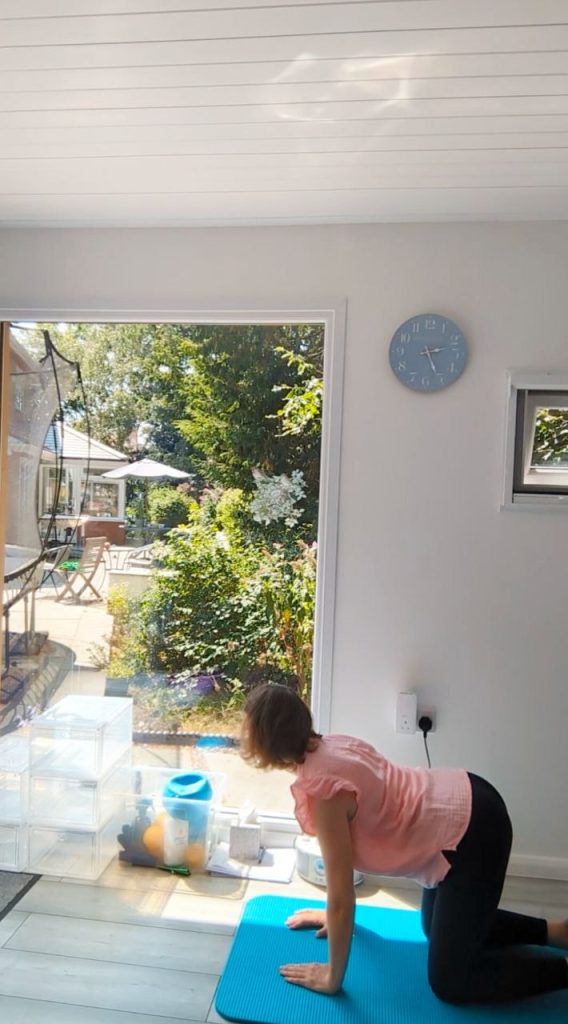
Threading the Needle – exhale bend right elbow, slide your left arm under, hinge at the hips and rotate your spine. Inhale & come back to the starting position. Exhale bring your left arm to the left side of your body & up, rotate your head & spine, look up at your hand & open fully across your chest & shoulders. Inhale come back to the starting position & neutral spine. Repeat to the other side.
Hypopressives – Breathing & Apnoea. Tuck your toes under, inhale & rock back maintaining neutral spine. Exhale & come forward. Do three deep ribcage breathing cycles. After the third exhalation hold the breath out & slowly expand your ribcage to the sides (only do apnoea if you have done it with me in the class). Repeat one more time.
You can replace hands with your elbows to relieve wrists. In this position look at your knees & keep spine & neck long.
Why it works: This combines ribcage breathing, re-alignment, articulation through your spine as well as diaphragm & pelvic floor muscles integration. Plus, you are strengthening your arms.
Coming Next Month
Shoulder girdle and mid back release
Ready to move with confidence?
If you’d like to improve your strength, posture, balance or pelvic floor health in a supportive small-group environment, I’d love to welcome you to one of my Pilates classes in Bidston or a private session.